

This past week saw the announcement of a “detransition clinic” at Texas Children’s Hospital, said to be the first of its kind in the United States. The establishment of the clinic comes as a result of a settlement with the US Department of Justice and the Texas Attorney General’s Office after the hospital was accused of using false ICD-10 codes to illegally bill for pediatric transition services.1
The clinic offers free services for patients up and inclusive of age 21 and also offers detransition-related obstetric and gynecologic care for patients older than age 21.2
Detransition-specific services are also available at the Cleveland Clinic.3 This was also the result of a settlement with the US Department of Justice, again related to healthcare fraud. The Cleveland Clinic, by contrast, has not established a specific “detransition clinic” and clarifies that it was already offering the care that the settlement stipulates. The services are to be offered to people who accessed transition-related care before the age of 19.4
As a third option completely unrelated to the first two, detransitioners can also use the Resilience Health Network to become connected with health care providers.5 As a side note, I can say confidently that I know RHN has consulted directly with detransitioners in order to find out what sort of medical needs we are interested in. (I have not used the network, though, so I cannot offer any personal experience beyond that!)
The Good
People who have detransitioned do often require specialized services. This is something that providers of “gender-affirming care” have failed to address and that trans activists have failed to grapple with. The most recent WPATH standards of care includes only one section directly addressing detransition (statement 5.7 in the “assessment of adults” chapter), which largely assures readers that detransition is rare and that most people are satisfied after transition rather than providing practical guidelines for care.6 (It devotes an entire brand-new chapter to addressing the medical needs of people who identify as “eunuchs,” though.)
Medical professionals who are familiar with providing gender-affirming care seem to behave as though “detransition” is a second transition. Ask for the new name and pronouns and prescribe the proper hormones, if necessary. Indeed, some of the criticism of the new clinic suggests that “detransition care” can simply be done at existing clinics for gender transition.
Frankly, though, a lot of detransitioners don’t want to keep seeing the same medical professionals who transitioned them. Some of us believe we have been misdiagnosed and given a treatment that, at best, did nothing for us and, at worst, ruined our lives. Why would we want to go back to the same place?
Texas Children’s and Cleveland Clinic both advertise access to experts in the following specialties:
Primary care providers
Endocrinologists
Plastic surgeons
Psychologists
Gynecologists
Texas Children’s also advertises access to fertility counseling, social work and case management, and speech pathology; Cleveland Clinic advertises access to urologists. (It’s possible both offer access to all of these specialties if you call and ask them, but I haven’t done so.)
These are, in fact, the kinds of post-treatment services that detransitioners tend to ask for.
We have concerns about how hormones have already affected our bodies; about how introducing new exogenous hormones might affect our bodies; about how living without any sex hormones might affect our bodies; and about individualized hormone dosage separate from what is recommended by providers of transgender-related care.
We have concerns about surgeries that we have undergone; about whether it is possible to have surgeries that repair function; about whether or not we should undergo further cosmetic surgeries; and about what we can expect going forward.
We have concerns about whether we are still fertile post-transition; about whether becoming pregnant will harm our unborn children; and about how to replace breastfeeding if we are post-mastectomy.
We have mental health concerns after transitioning that include experiences of guilt, shame, betrayal, anger, regret, sadness, grief; we are unsure how to move on with our lives; we need people who can guide us through the process and help us onto the right pathways.
Access to qualified people who are able to answer all of our questions is what a “detransition clinic” should ideally offer.
I will be frank, though. I believe that all of these services should be offered to anyone outside of a detransition-specific clinic, and ideally, this is how we move forward in the future. Unfortunately, this is simply not the reality of how things are going today.
I can think of at least two examples of detransitioned people who saw specialist doctors (an endocrinologist and a urologist, respectively), where both specialists basically acted like they had no idea how to treat the person in front of them, and both of whom then tried to make referrals to providers who specialized in transgender health care. (Neither patient wanted anything to do with gender clinics.)
That said, I do think that there is a very obvious upside to having “detransition clinics” where lots of information about people who are going through the detransition process are all in the same place, which is that it makes it a very good environment for research.
I hope that access to this kind of information will help clinicians to actually come up with guidelines on how to taper people off of hormones; which kinds of effects are permanent and which are not; general timelines of bodily changes after hormones have been discontinued; the percentage of detransitioners who pursue further cosmetic surgeries versus those who don’t; what options are available to a post-testosterone female having vocal issues; what’s going on with the bones of people who were on puberty blockers; what kinds of psychological issues remain after detransition… there’s certainly dozens, even hundreds, of questions that could be answered.
The Bad
Although I want to be optimistic about “detransition clinics,” I remain skeptical of the medical industry as a whole because of what I’ve been through, and my biggest concern is that they will end up developing guidelines that place people into boxes or that end up too standardized.
Detransition is an incredibly individual process, and we know very little about how to support the well-being of people who formerly accessed sex-rejecting procedures and are trying to heal and move forward.
I certainly see value in being able to approach a clinic with medical needs already in mind, but I worry about clinicians trying to be overly helpful by suggesting procedures that are unnecessary. For example, say a clinician has a checklist of things to go over during intake. I fear that going through this list and asking a woman “Are you interested in breast reconstruction?” “Are you interested in vocal surgery?” places thoughts of those procedures into her head, even if she has never thought about it before and isn’t aware of what realistic outcomes look like.
This becomes even more of an issue if those surgeries are being offered free of charge. We’re talking about a population of people who are historically impulsive and emotionally dysregulated. Depending on how recently they made the decision to detransition, they might be in an extremely vulnerable and desperate state of mind. This is the worst time to be making decisions about further permanent cosmetic changes.
I worry that clinics themselves – not existing ones specifically, but future ones – will eventually become more like existing “gender-affirming” services, focused on advertising a wide range of cosmetic procedures rather than on radical acceptance and slow consideration of next steps.
I worry that people who are developing the same kind of dissatisfaction with not being feminine or masculine enough, as they did in transition, will be encouraged to pursue multiple surgeries as a means of resolving the tension within themselves.
I worry about false promises being made of “getting your body back” when the truth is that our bodies can never be “unmutilated.” Many of us were in transition during critical development periods or for so many years that we genuinely don’t know what we were supposed to look like at the age we are now.
I worry that doctors will end up developing a standard of what it means to “properly” detransition to the point where people will, for example, be harassed for failing to undergo breast reconstruction (for females) or gynecomastia reduction surgery (for males).
Another issue, of course, is that some of these existing detransition services are age-limited. I’ve spoken for years about my worries that those who transitioned later into adulthood would be abandoned by medical professionals, and that worry seems to be coming to fruition right before our eyes. It’s disappointing, to say the least. Children aren’t the only vulnerable population.
The Ugly
Transitioners and allied activists are already throwing tantrums over the existence of detransition-specific services by claiming that “detransition clinics” are nothing more than “conversion camps” where people will be sent to be “tortured.”
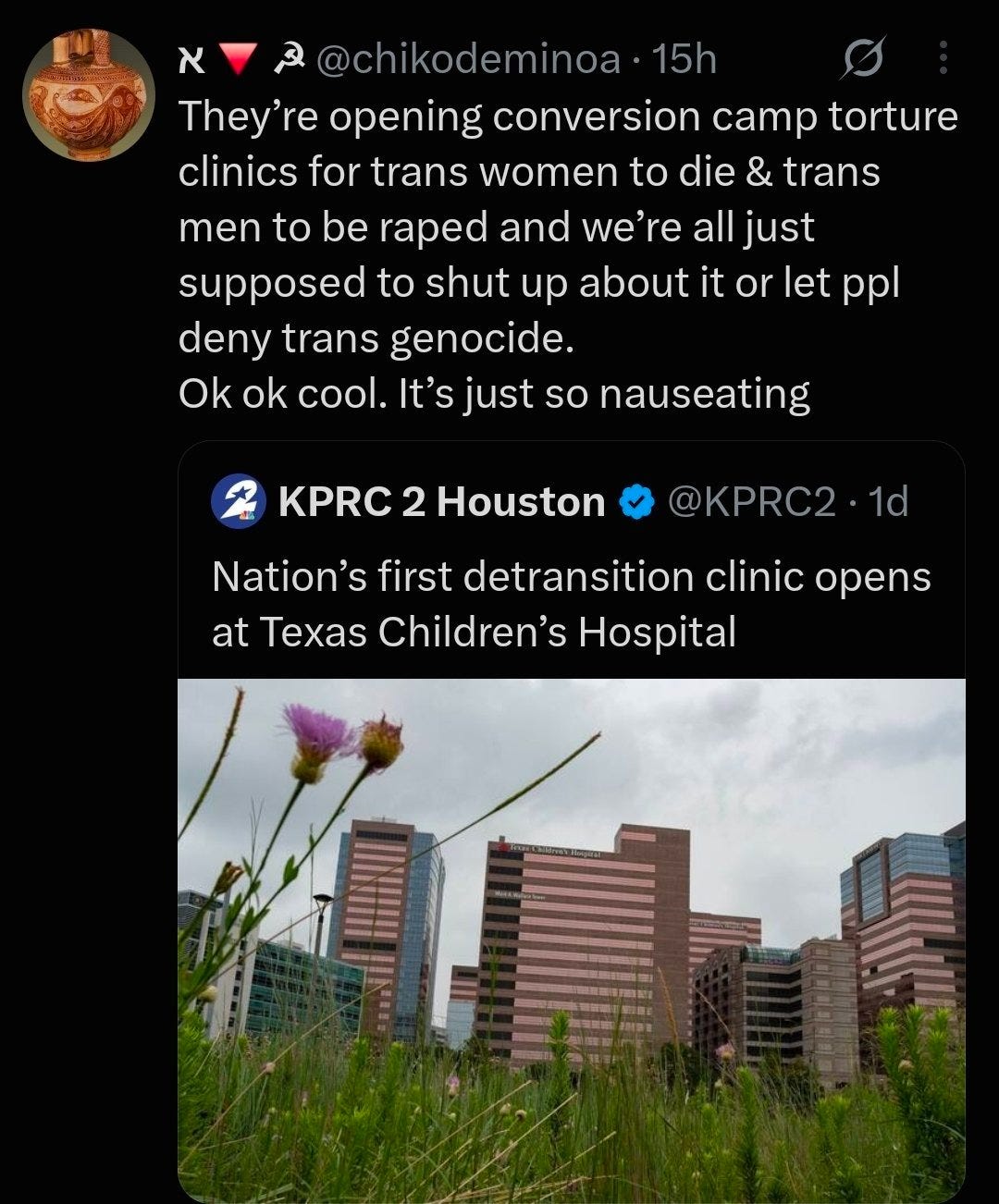
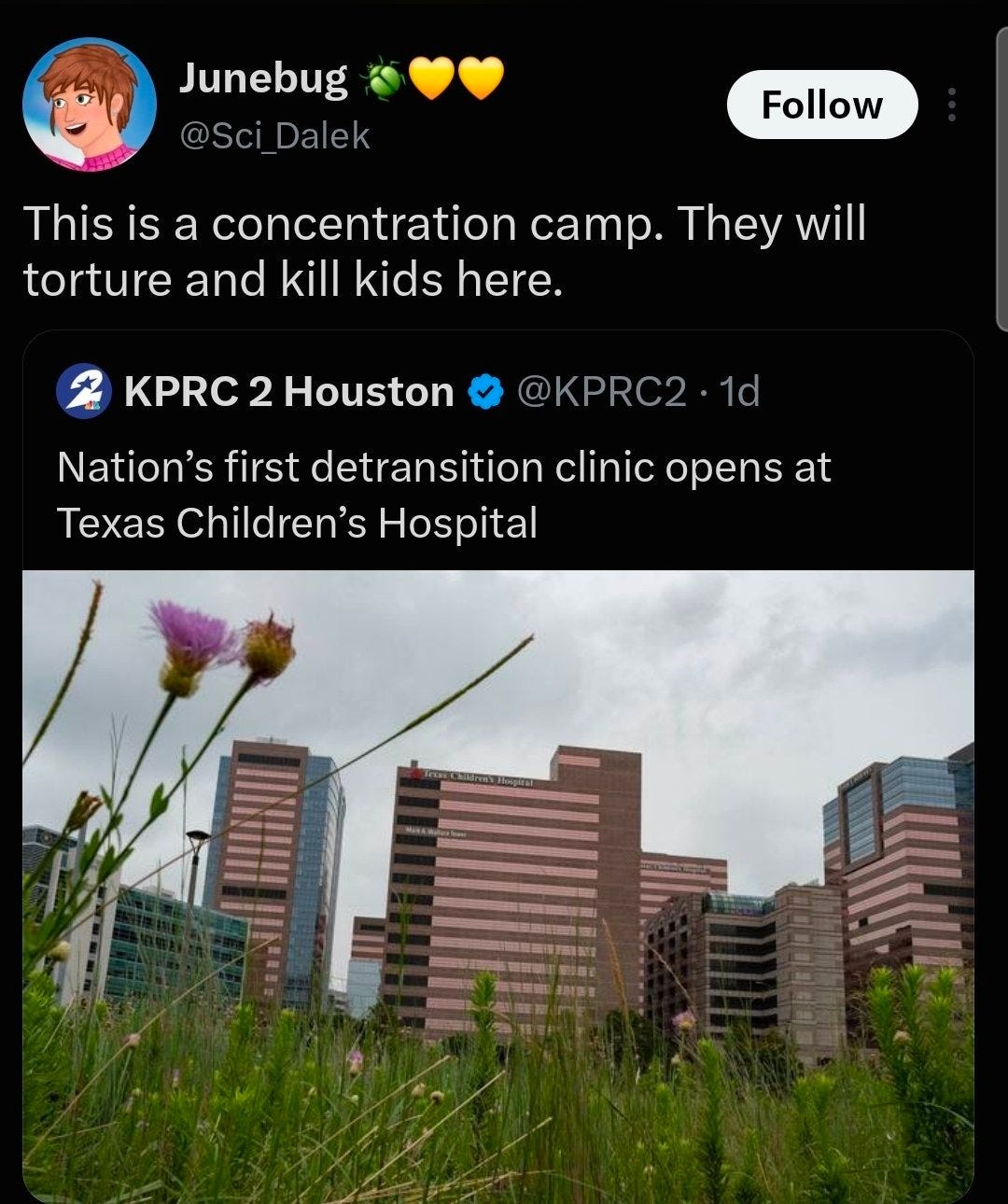
This is, of course, fearmongering nonsense.
Firstly, this isn’t a residential treatment centre, so it doesn’t in any way qualify as a “camp.” No one’s being dropped off and left behind.
Secondly, parents wouldn’t take their children to a “detransition clinic” in order to stop a transition. They just wouldn’t consent to their child beginning a transition in the first place.
Texas Children’s clinic is set up for people who are detransitioning or who intend to detransition of their own free will. Every single sign of what will happen at this place is that people go through an intake process to determine what sort of help the patient is seeking, and then they are referred to those specialists.
It’s extremely histrionic to think that parents are going to be dragging in their children against their will to see a qualified therapist, who then systematically and brutally tells the child everything they don’t want to hear, while that child sobs, surrounded by dozens of people who take absolutely no notice of what’s happening. There are zero indications that that is how this clinic is going to function, and the idea that anyone would get away with it in a regulated medical setting is ridiculous.
It’s a multidisciplinary clinic established to primarily provide care to people who have already undergone medical procedures. It’s for post-treatment care, not “preventative” care.
Rather than showing sympathy towards detransitioners requiring health care, trans activists have once again managed to turn a non-issue into something in which they are the victims.
Detransitioners may have a lot of negativity about transition, and trans activists may claim that this is the reason they have no concern for our well-being, but if they’d been willing to address our needs decades ago — instead of going on about how we were too rare to think about — perhaps we wouldn’t be in this predicament to begin with.